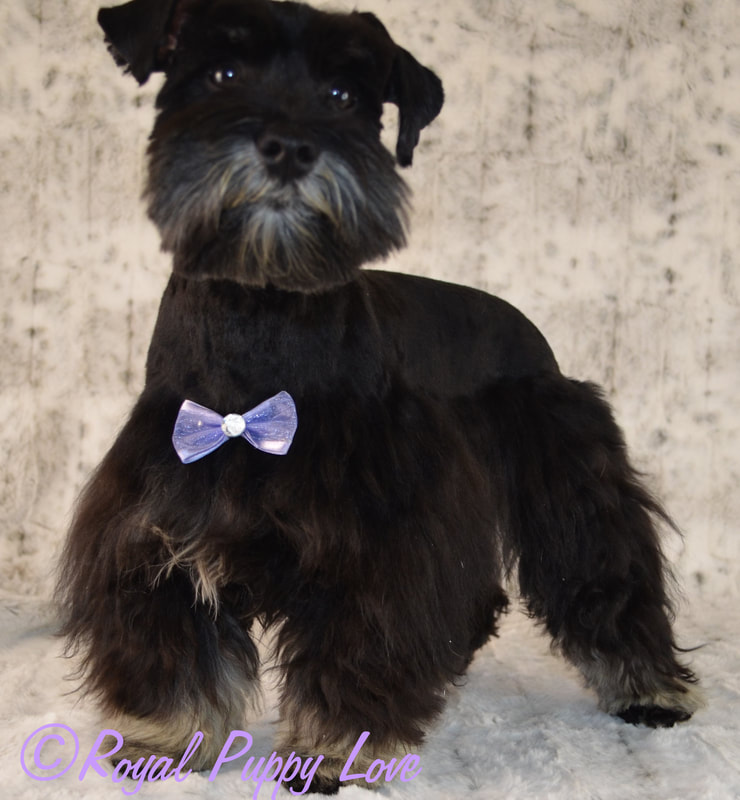
All About the Miniature Schnauzer
Bold spirit. Brilliant mind. Loyal heart.
Personality
Spirited, clever, expressive, and devoted to family life.
Bright & Eager to Learn
The Miniature Schnauzer is alert and spirited, yet obedient to command. They do well with owners who like to teach “tricks” and play games. They are often accused of understanding every word you say and enjoy it when you talk to them. They are friendly, intelligent and willing to please which makes them very easy to train and wonderful with children and other animals.
A Natural Watchdog
The Mini Schnauzer makes an excellent watchdog. They are suspicious of strangers until the owner of the home welcomes the guest, after which they are typically very friendly. Miniature Schnauzers are not aggressive by nature and tend to love everyone they meet. They are relatively fearless, and once mature, the Miniature Schnauzer has a strongly developed territorial instinct. They are ideal watchdogs, defending by barking and raising a fuss rather than through physical confrontation. A good Mini Schnauzer will bark at anyone who may appear a threat to his home, but is not an incessant barker. They are discriminating and intelligent guard dogs that assume this duty naturally. Miniature Schnauzers are highly intelligent and generally easy to train.
Playful & Mischievous
They are playful dogs, but if you ignore them, they may become bored and mischievous. My Schnauzers have been known to hide my husband’s work boots because they don’t want him to leave. Mini Schnauzers are highly prey-driven and may attack other small animals such as birds, gophers, squirrels, and rodents. Schnauzers get along with the family cat but may occasionally chase the cat for fun. As soon as the cat hisses, they go find someone else to play with them.
Everyday Care
A practical companion with an unmistakable Schnauzer presence.
Grooming
Schnauzers do not shed and are recommended for people with allergies because they do not generally have pet dander. Schnauzers are a ‘wash-and-wear’ type of dog. They need a bath once or twice a month (unless they get really dirty). You can have them groomed professionally every other month or you can easily learn to do it yourself. Brush them out after their bath, clip their toenails once a month, clean their ears when they are groomed, and that’s about it. They are pretty easy. See the Grooming page for detailed instructions here.
Size
According to the official AKC conformation standard, Miniature Schnauzers are 12 to 14 inches at the shoulder. The AKC’s current breed weight chart lists both males and females at 11 to 20 pounds.
Size — What about “Toy and Teacup” Schnauzers?
Understanding breed, height, weight, and the informal size terms families often hear.
Ah—this is where it is important to understand the difference between the “Breed” of the dog and the “Size” of a dog. Miniature Schnauzer is the breed and, while the breed name does include the word “miniature” it does not mean that any dog who isn’t exactly 12 to 14 inches tall and doesn’t weigh between 12 and 20 pounds isn’t a Miniature Schnauzer.
Put in human terms, “Miniature Schnauzer” would refer to your heritage or your lineage but it has nothing to do with how tall you are or how much you weigh. My husband is Native American (his heritage) but he is also tall, and slightly pudgy (don’t tell him I said that). Just because he is taller than average, or heavier than what the doctor says he should be, that doesn’t mean he isn’t Native American.
Miniature Schnauzers are exactly the same. The terms “toy and teacup” refer more to their size and weight and not to their heritage (breed). So all Miniature Schnauzers are registered as Miniature Schnauzers no matter what color they are, how tall, short, skinny, or fat they are. What makes them Miniature Schnauzers is their bloodlines—their heritage. It is that simple.
However, where it gets complicated is when the public (including breeders) mean different things when they say a puppy will be a “toy size” or a “teacup size.” Each person means something different by these terms so it is important that you understand what your breeder means when they use these terms. Here are my guidelines for the common Miniature Schnauzer sizes:
Miniature Schnauzer
Miniature Schnauzer: 12 to 14 inches tall and typically between 12 and 20 pounds at one year of age.
Toy Size
Toy Size: 9 to 11 inches tall and typically between 8 and 12 pounds at one year of age.
Teacup Size
Teacup Size: under 9 inches tall and under 8 pounds at one year of age.
Micro Teacup size: under 5 inches tall and under 4 pounds at one year of age.
I do NOT breed for this size and will not intentionally breed a puppy this size. Any puppy under this size is most likely sickly and/or has a liver shunt problem.
Ears, Tails, Dew Claws, etc.
The Miniature Schnauzer is typically seen with its tail docked, dew claws removed and the ears may or may not be cropped. All of my puppies are sold with natural ears, so you may have them cropped when your puppy is 10-12 weeks old if you want. Because Schnauzers are prey driven and may dig to catch their prey, all puppies should have their dew claws removed before they are a week old or they run the risk of ripping off their dew claws while in pursuit of their prey, while digging, or reaching through a chain-link fence.
History
From German farm dog to cherished family companion.
The Miniature Schnauzer originated in Germany in the late 1800s. They were originally bred for guarding herds and farms, and for keeping rats and vermin out of the barns. In the Mini Schnauzer’s earliest stages, several small breeds were crossed to bring down the size of the well-established Standard Schnauzer. The goal was to create a duplicate but in a much smaller size.
Crossing with breeds such as the Affenpinscher, Poodle and Miniature Pinscher had the side effect of introducing colors that were not considered acceptable to the ultimate goal. As breeders worked toward the stabilization of the gene pool, they stopped breeding mismarked parti-colored, liver, and white puppies (the colors that were introduced by the Affenpinscher, Poodle and Miniature Pinscher).
Although the Miniature Schnauzer also comes in liver (chocolate), wheaten (blonde), liver & tan, and solid white, the AKC only recognizes solid black, Salt & Pepper, and Black & Silver in conformation show events. The AKC will register the other ‘rare’ colors but they are not allowed to be shown.
Living Well With a Miniature Schnauzer
Training, longevity, and health awareness.
What to worry about
The best Miniature Schnauzers are very smart and capable of learning a great deal, but they must be taught at an early age that they are not the rulers of the world. The persistence that makes them suited to killing vermin can be annoying when you try to teach them anything. Some, but not all, Miniature Schnauzers want to be the boss and will make you prove that you are in charge. You must show them that you mean what you say by being consistent. You cannot give in to them even one time—they will never forget it if you do. So if you don’t want your puppy to sleep in your bed, don’t let them on your bed—ever! Everyone in the house must know the rules and stick to them or a Schnauzer will quickly learn who is “easy” and who isn’t. They are that smart! See more information about training your Miniature Schnauzer on our Training Page here.
Average Life Span
Miniature Schnauzers are a fairly healthy breed living an average of 14 years. Most act like puppies and are happy, loving companions their entire life.
Known Health Issues
The Miniature Schnauzer as a breed is not plagued with many prevalent health issues. However, there are a handful of rare diseases to look out for. Not all Miniature Schnauzers will get any or all of these diseases, but it’s important to be aware of them if you’re considering this breed.
Colors
The classic standards, less-common colors, and registration details.
Schnauzers come in all sorts of colors including the “standard three” of Black, Black & Silver, and Salt & Pepper. Less common colors (‘rare colors’) include solid White, Wheaten (blonde, champagne), Liver (chocolate), Liver Pepper, and Liver & Tan. All of those same colors are available in solid colors and Parti colors. Parti refers to the dog being partially (parti) white with another color, usually in large patches. So a dog may be a Black and White Parti, Salt & Pepper Parti, Liver Parti, Wheaten Parti or Liver & Pepper Parti.
Here are the AKC color codes for the various colors:
Important note for AKC registration of rare colors!
When registering your puppy with the AKC, it is necessary to include two photos along with your puppy’s AKC registration paperwork. The photos must be a full front view as well as a side view of the puppy. All variations of the Liver color (Liver, Liver Tan, Liver Pepper), all Parti colors, as well as White and Wheaten must include photos with the AKC paperwork. Address the envelope to the AKC and mark it with: “ATTN: KARLA DEITHORN-SPECIAL SERVICES” in order for your paperwork to be processed quickly.
Coat Types and Colors
What’s up with the “Mega Coat,” “Standard Schnauzer Coat,” “Super Mega Coat,” and “Wire Coat”? What is the difference?
Predicting a Puppy’s Adult Coat
First, let me say it is nearly impossible to tell with any certainty the final coat type (the thickness, texture, whether wiry or soft, etc.) of a puppy before he or she is 6 months old. An educated guess based on the genetics of the puppy is the best anyone can do.
Standard or Wire Coat
Typically, you have “Standard Show Coat” guidelines in any purebred dog. These can easily be found on the AKC website but in part say: Double, with hard, wiry, outer coat and close undercoat. Furnishings (the skirt) are fairly thick but not silky. Faults – Coat too soft or too smooth and slick in appearance. The standard show coat is also referred to as a “Wire Coat” because it does not feel soft, has little to no curl, and it feels rough like a horse’s tail. It is also resistant to matting and tangling. A Wire Coated Schnauzer can roll in the leaves, dash through a mud puddle, dig in the yard, chase the kids everywhere, then shake himself off and plop on your couch without a care– because, for the most part, a Wire Coated Schnauzer has a low maintenance fur, for the average family (unless you want to show; that is a whole other story!). This type of coat is called a “German Coat,” a “Wire Coat,” a “Show type Coat” or a “Standard Coat.”
Mega, Super-Mega & Glamor Coats
The “Mega Coat,” “Super-Mega Coat,” and “Glamor Coat” are soft, silky, thicker, and more luxurious. The coat usually has some curl or waves. It is a beautiful, lovely, easy-to-fall-in-love-with look on a Miniature Schnauzer. Furnishings can vary from somewhat thick (Mega Coat) to extremely thick (a Super-Mega coat).
About the Merle Pattern
What about the “Merle Schnauzer”? The Merle color pattern is problematic because it carries blindness, deafness, and oftentimes an immune-system defect. The gene that causes the Merle pattern may also negatively impact hearing, eyesight, the organs, and the immune system.
Meet the Available Puppies
Take your time getting to know the Miniature Schnauzers currently looking for their perfect families.
Meet the Available Puppies